General Information

Scope
BIANISOTROPICS 2000 will
be the 8th
International Conference on Electromagnetics of Complex Media. The Conference
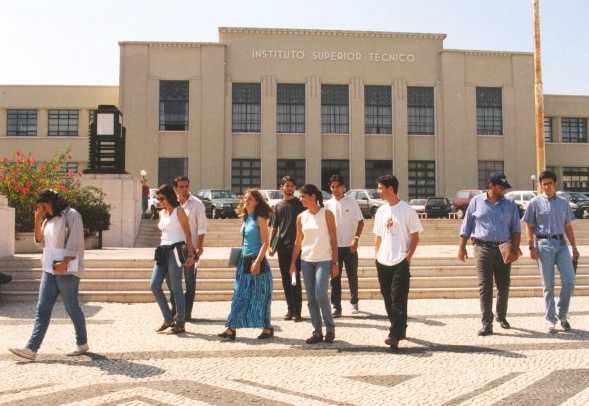
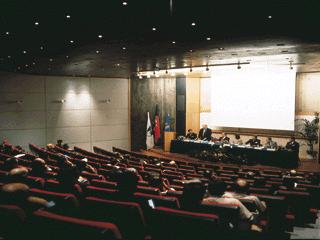
will be held at the Congress Center of Instituto Superior Técnico,
Universidade
Técnica de Lisboa.
The meeting will cover from fundamental
electromagnetic theory of complex media to applications and novel devices from
the microwave to the optical regimes.
The conference will comprise 6 half-day
sessions on a variety of research topics concerned with theory and applications
of complex (i.e., chiral, pseudochiral, anisotropic, bianisotropic,
nonhomogeneous, nonlocal, nonlinear, random) media. The programme will include
special talks by key speakers, oral and poster sessions with contributed papers
and discussions on hot topics bringing together applied mathematicians,
physicists, engineers, material scientists from Research Institutes,
Universities and Industries.
Historical
background
Bianisotropics 2000 will be the eighth in a series of loosely connected international conferences and workshops and concerned with all aspects of
electromagnetics relating to novel materials.
Its predecessors were:
-
Bi-isotropics'93 - Workshop on Novel Microwave Materials, February 1993, Helsinki University of Technology, Finland;
-
Bianisotropics'93 - Seminar on Electrodynamics of Chiral and Bianisotropic Media,
October 1993, Gomel, Belarus;
-
Chiral'94 - 3rd International Workshop on Chiral, Bi-isotropic and Bi-anisotropic Media,
May 1994, P\'erigueux, France;
-
Chiral'95 - International Conference on the Electromagnetic Effects of Chirality and its Applications,
October 1995, The Pennsylvania State University, USA;
-
Chiral'96 - NATO Advanced Research Workshop, July 1996, St. Petersburg - Moscow, Russia;
-
Bianisotropics'97 - International Conference and Workshop on Electromagnetics of Complex Media, June 1997, Glasgow,
Great Britain;
-
Bianisotropics'98 - 7th International Conference on Complex Media, June 1998, Braunschweig, Germany.
Since their inception in 1993 these conferences/workshops have proved highly successful meetings for scientists actively working in this
particular area of research. They have provided a stimulating setting for the exchange of research results, the development of new directions
of theoretical and experimental research and the fostering of new research collaborations. Equally importantly, they have provided a platform for
vital mutual interaction between East and West in attracting scientists from the Former Soviet Union, their participation made possible through
generous grants.
Scientific background,
motivation and aims
During much of the 19th century and until quite recently in this century, electromagnetics researchers focussed on either vacuum or metals or
dielectric media such as crystals, powders, epoxies and plasmas. Some attention was paid to magnetic materials as well, chiefly at
low frequencies. During the 1960s, however, attention began to be sporadically focussed on general electromagnetic media.
Although nonlinear dielectric media quickly became very important in optics owing to their technological significance, advances in materials
sciences were very slow so that general (i.e., bianisotropic) media were considered important only by a few theorists.
This picture began to dramatically alter during the mid-1980s. Chiral media arrived on the scene, with the possibility of being
technologically significant at microwave frequencies. This became possible owing to huge advances in polymer sciences:
biomimetic materials as well as extremely long-chain polymers with chiral conformations make chiral
media attractive for electromagneticists. The study of the optical properties of enantiomers has been boosted
by the recognition of enantioselectivity by the pharmaceutical industry. The chirality of ocular media
has been targeted for noninvasive monitoring of blood glucose in diabetics. More recent advances in
thin film technology are yielding new forms of smart composites and functional gradient materials. Helicoidal bianisotropic
mediums have been proposed and fabricated, and have given rise to the sculptured thin film concept for use in solid
optics, bio-ultrasonics, transduction, microcatalysis, and many other areas.
A major new thrust area is in combining the fast electromagnetic responses of most materials with their relatively slower mechanical responses,
giving rise to electromagnetically controllable smart materials for transduction and
actuation. Typically, these are composites so that their electromagnetic as well as mechanical responses have desirable attributes. Moreover,
they may be inhomogeneous in order to possess functional gradients.
Complex media require the attentions of scientists from a wide spectrum of disciplines:
from Applied Mathematics and Physics to Electrical and Electronic Engineering, from Chemistry to Materials Science,
and even Biophysics. Thus, the electromagnetics of complex media is indeed a truly multidisciplinary research area spanning the bridge
from basic theoretical and experimental research at universities to industrial production of a diverse array of electrical, microwave,
infrared and optical materials and devices.
All of this means that the study of electromagnetic fields in bianisotropic media is no longer merely
the province of ivory-tower theorists, but a vibrant area of technological research as well with
great promise for societal benefits.
Local organizers
A. M. Barbosa (Technical University of Lisbon) - Conference Chair
A. L. Topa (Technical University of Lisbon)
Organizing committee
J. H. Cloete (University of Stellenbosch, South Africa)
N. Engheta (University of Pennsylvania, USA)
A. Jacob (Technische Universität Braunschweig, Germany)
Igor Semchenko (Gomel State University, Belarus)
A. Sihvola (Helsinki University of Technology, Finland)
S. Tretyakov (St. Petersburg State Technical University, Russia)
U. B. Unrau (Technische Universität Braunschweig, Germany)
A. P. Vinogradov (Russian Academy of Science, Russia)
W. Weiglhofer (University of Glasgow, Great Britain)
Scientific advisory committee
J. M. Arnold (University of Glasgow, Great Britain)
W. C. Chew (University of Illinois, USA)
H. Cory (Technion-Israel Institute of Technology, Israel)
D. L. Jaggard (University of Pennsylvania, USA)
G. Kristensson (Lund Institute of Technology, Sweden)
C. Krowne (Naval Research Laboratory, USA)
A. Lakhtakia (Pennsylvania State University, USA)
I. Lindell (Helsinki University of Technology, Finland)
F. Olyslager (University of Ghent, Belgium)
J. P. Parneix (PIOM, France)
G. Ya Slepyan (Belarus State University, Belarus)
S. Ström (Royal Institute of Technology, Sweden)
K. W. Whites (University of Kentucky, USA)
Schedule
April
22, 2000: deadline for one-page abstracts
May
22, 2000: notification of acceptance
July
5, 2000: reception of final manuscripts and registration
Organization
The Conference is organized by:
Sponsors
The meeting is receiving sponsorship from:
-
European Union, D. G. Information Technology
-
U. S. Office of Naval Research
-
Fundação para a Ciência e Tecnologia (Foundation for Science and
Technology), Portugal
-
Universidade Técnica de Lisboa
-
Fundação Luso-Americana para o Desenvolvimento (Luso-American Development
Foundation), Portugal
-
Fundação Calouste Gulbenkian, Portugal
-
PT (Portugal Telecom) - Inovação
-
IEEE MTT, Region 8
and technical co-sponsorship from
- IEEE Electron Devices Society
-
IEEE AP/MTT/ED/SSC Portugal Chapter
-
URSI.



Registration fee
The following registration fee is to be paid in cash (PTE
- Portuguese Escudos) upon arrival at the conference:
|
Registration Fee
|
| Regular |
32 000 PTE |
160 EURO |
| Reduced rate - Student |
16 000 PTE |
80 EURO |
The registration fee includes one copy of the Proceedings, lunches, refreshments and
attendance at the social event. Conference Dinner extra tickets for accompanying persons, can be
purchased at the Conference Desk, no later than September 27, at
the unit price of 10.000 PTE. Assistance with accommodation arrangements is provided by the organizers.